


IP NEWS IN JAPAN
Trends in Distinctiveness Determinations in Japan
In recent years, trademark distinctiveness determinations in Japan have shown a tendency to become more stringent overall, and as a result, the success rate in appeal trials against refusals has been gradually declining.
In this circular, we outline the latest trends in distinctiveness determinations and propose practical strategies to help avoid refusals based on lack of distinctiveness.
- Changes in Distinctiveness Determinations (Statistics and Case Examples)
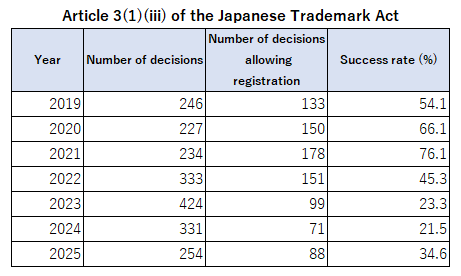
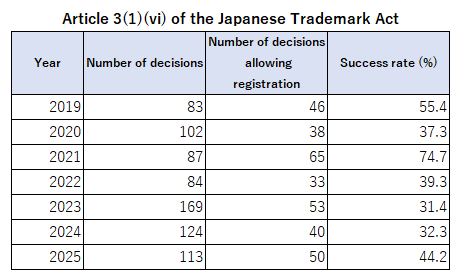
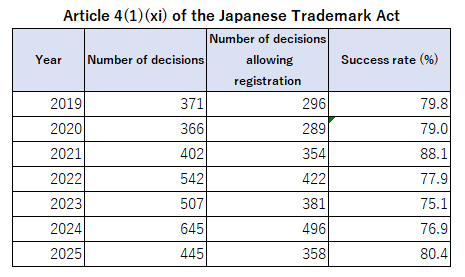
We calculated the success rates [1] in appeal trials against refusals based on lack of distinctiveness for the period from 2019 to 2025, using data extracted from J-PlatPat’s (JPO Database) “Appeal/Trial Decision Search.”
As a result, it was confirmed that, for both Article 3(1)(iii) and Article 3(1)(vi) of the Japanese Trademark Act, the success rates have declined sharply since 2022.
From this statistical perspective as well, it is evident that distinctiveness determinations have become more stringent than in the past.
By contrast, with respect to Article 4(1)(xi) of the Trademark Act, except for 2021, the success rates have shown a relatively stable trend compared with those under the various provisions of Article 3, indicating a different tendency from that seen in distinctiveness determinations.
(1) Case Examples
- Period during which distinctiveness determinations were relatively lenient (up to around 2021)
Registration Example: Appeal No. 2020-005188 (Decision date: July 8, 2021)
Applicable provision: Article 3(1)(iii) of the Japanese Trademark Act
Mark:

Classes: Class 35 personnel placement, recruitment of personnel, employment placement, and provision of guidance, consultancy and information relating to personnel placement, employment placement and recruitment, etc.
Summary of the decision: Even if the wording “Cross Border Recruitment” may in some cases suggest the meaning of “recruitment of newcomers across national borders,” in relation to the designated services of the present application, it is difficult to say that it would be immediately understood as directly indicating the quality of the services. Therefore, it is capable of fulfilling the function of distinguishing one’s own services from those of others, and the refusal is set aside.
Our view: This is a case in which registration was granted by demonstrating that, although there were some third-party uses, the number of such uses was limited, and the term was not generally used in trade practice. In the refusal issued at the examination stage, three examples were cited as instances of use of the applied-for mark. However, at the appeal stage, evidence was submitted showing that one of those examples was attributable to the applicant, and that none of the service menus of fifteen major competing companies contained any use of the applied-for mark. As a result, it was found that the applied-for mark is not commonly used as directly indicating the quality or characteristics of the services, nor is it perceived as such by consumers, and therefore it was held to possess distinctiveness and was registered.
- Period during which distinctiveness determinations became more stringent (from around 2022 onward)
Refusal Example: Appeal No. 2023-012909 (Decision date: June 17, 2024)
Applicable provision: Article 3(1)(iii) of the Japanese Trademark Act
Mark:

Class: Class 35 recruitment of personnel, employment placement, and provision of job information, etc.
Class 41 providing electronic publications; providing videos via the Internet; providing music via the Internet, etc.
Summary of the decision: In light of the meanings of the individual constituent words of the applied-for mark and the actual circumstances in which various activities conducted by business operators for recruiting and hiring personnel are carried out using electronic three-dimensional spaces existing on the internet (hereinafter referred to as “the metaverse”), the applied-for mark as a whole readily conveys the meaning of “personnel recruitment and hiring using the metaverse.” Therefore, distinctiveness was not recognized, and the mark could not be registered.
Our view: This is a case in which distinctiveness was denied based on the actual state of trade in which recruitment activities are conducted using the metaverse, even though there were no examples of use of the mark as a whole.
In this case, despite arguments that there were no actual examples of use and that the constituent terms allowed for multiple interpretations, the mark was found to lack distinctiveness. When compared with the “Cross Border Recruitment” case—where registration was granted even though some usage existed—this decision clearly reflects the trend toward increasingly strict assessments of distinctiveness.
- Changes in the Method of Distinctiveness Determinations (for Composite Marks)
Prior to 2021, in determining the distinctiveness of composite marks, the following points were primarily taken into consideration:
- There were few or no examples of use of the mark as a whole.
- The constituent terms allowed for a range of interpretations, and even somewhat strained interpretations could reasonably give rise to multiple possible meanings.
- The manner of combination or usage of the constituent terms was, to some extent, unnatural.
Where such circumstances were present, it was considered difficult to immediately identify a specific meaning from the mark as a whole, and relatively broad scope was afforded for finding distinctiveness.
By contrast, since around 2022, there has been a clear tendency to adopt a determination approach whereby the meanings of the constituent terms are individually scrutinized, and the meaning of the mark as a whole is then derived from their combination. In other words, even if no actual use of the mark as a whole can be confirmed, if a reasonable meaning can be inferred from the combination of the constituent terms, the mark may be deemed non-distinctive.
As a result, composite marks are now more likely to be found lacking in distinctiveness than under prior practice.
It is also considered that, in the background to this shift in determination methodology, there were numerous comments from external sources (such as practitioners and users) from around 2018 onward criticizing that distinctiveness determinations had been overly lenient.
- Impact of the Stricter Distinctiveness Determination
As the determination of distinctiveness becomes more stringent, an increase in refusals at the examination stage can be expected. In addition, even where past registration precedents are cited in arguments, their persuasive effect on examiners has become increasingly limited. As a result, predicting the likelihood of registration is becoming more difficult than before.
Furthermore, when it becomes necessary to submit arguments in response to a refusal, the associated Japanese agent fees tend to be higher than those incurred when addressing the refusal solely through amendments to the application, which is another factor that cannot be overlooked.
In light of the above, the cumulative effect of the following factors raises concerns:
- Reduced predictability of registrability
- Increased costs for responding to refusals.
These trends may lead to a growing tendency to refrain from filing applications in the first place, or to accept refusals without contest rather than pursuing arguments against them.
- Our Recommendations
(1) Effective Use of Pre-Filing Searches
While the results of pre-filing searches do not guarantee registrability, with respect to distinctiveness it is possible to achieve a certain degree of predictability by reviewing recent examination practices and appeal decisions.
In particular, in the current environment where distinctiveness determinations have become more stringent, understanding examination trends at the pre-filing stage is increasingly important from a risk-management perspective.
(2) Reconsideration of Brand Strategy
Where the manner of use has already been established, the general principle is to seek protection in accordance with the actual use.
At the same time, it has long been common practice to obtain rights in standard characters and then use the mark in various forms that fall within the scope of what is regarded as “socially identical.”
Nevertheless, in today’s situation where distinctiveness determinations have become increasingly stringent, filing a word mark composed of terms that indicate the nature or content of the goods or services may result in refusal on the ground of lack of distinctiveness, even though such a mark might previously have been registered as a suggestive mark.
In such cases, one option is to select and file a different mark with inherently stronger distinctiveness from the outset.
However, word marks composed of terms that indicate the nature or content of the goods or services have the advantage that their meaning can be intuitively understood from the name itself, making them highly appealing and effective from a consumer-facing and branding perspective.
Accordingly, the following options are also well worth considering:
- Where there is a risk that a word mark composed of descriptive or indicative terms may be found to lack distinctiveness, first file the mark in a form with higher inherent distinctiveness—such as in combination with an independent figurative element or as a distinctive logo—and obtain registration in that form.
- By securing such a registration, it is possible to deter, to a certain extent, third-party use of the wording, and after acquiring distinctiveness through use, subsequently consider seeking protection for the mark in standard characters.
It should be noted, however, that if a word-only mark and a combination mark consisting of wording and figurative elements are filed simultaneously, and the word-only mark is refused for lack of distinctiveness, the scope of protection of the combination mark will be clarified on the premise that exclusive rights do not extend to the wording itself.
Accordingly, a brand strategy that assumes step-by-step protection and aims ultimately to secure exclusive rights in the word mark alone may constitute an effective option in light of current trademark examination practice.
At our firm, we make continuous efforts to stay abreast of the latest developments in Japanese trademark examination practice.
When preparing arguments, we carefully review recent examination results and appeal decisions and conduct thorough internal discussions in order to develop effective lines of argument that are aligned with current examination practices and trends.
In addition, prior to filing, we conduct screening searches free of charge to identify potential grounds for refusal. Where a refusal based on lack of distinctiveness is anticipated, we communicate this possibility candidly and, where appropriate, propose alternative approaches such as modifications to the trademark.
We will continue to refine our expertise and remain committed to safeguarding our clients’ valuable brands with the highest level of care and reliability.
[1] Based on data extracted from the J-PlatPat (JPO database) “Appeal/Trial Decision Search,” the total number of decisions and the number of decisions allowing registration were identified for each statutory provision, and the ratio of decisions allowing registration was calculated as the “success rate.” Figures are rounded to the nearest whole number (second decimal place rounded).
- ITOH Patent Attorney Corporation
Tad ITOH, President
Yasunari HIGASHI, Trademark Attorney
Keiko NOZAKI, Trademark Attorney