


IP NEWS IN JAPAN
Consent System in Japan
We are pleased to note that nearly two years have passed since the consent system was introduced in Japan (effective April 1, 2024).
In this article, we would like to provide an overview of the key features of Japan’s consent system, as well as practical points to consider when making use of the consent system.
- Consent Systems in Various Countries
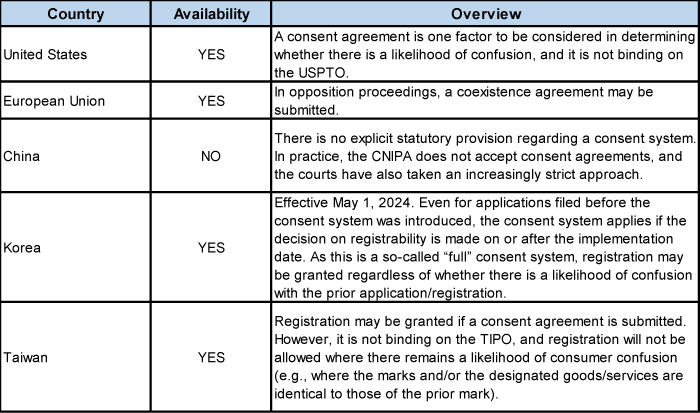
To help you better understand Japan’s consent system, we have summarized below an overview of consent systems in various countries.
- Japan’s Consent System
In Japan, the introduction of a consent system had long been deferred. This was largely because, even where an agreement had been reached between the parties, it was considered that there could still be cases in which the risk of consumers misidentifying or confusing the source of goods or services could not be eliminated with respect to similar coexisting trademarks.
However, against the backdrop of (i) the growing need to broaden the range of branding options for SMEs (Small and Medium-sized Enterprises) and start-ups seeking to launch new businesses by leveraging intellectual property, and (ii) the increasing demand for international harmonization of trademark systems, Japan’s consent system came into effect on April 1, 2024.
(1) Overview
- If there is a prior third-party trademark that is identical or similar to the applied-for mark, the JPO will issue an Office Action based on Article 4(1)(xi) of the Japanese Trademark Act.
- In response, if consent and an agreement are obtained between the applicant and the owner of the prior trademark, the refusal under Article 4(1)(xi) may be overcome pursuant to Article 4(4) of the Act, and the mark may proceed to registration.
- Prior to the introduction of the consent system, the main options for responding to a refusal under Article 4(1)(xi) were generally as follows:
- Arguing dissimilarity by filing a written opinion
- Deleting the conflicting goods/services by filing an amendment
- Filing a non-use cancellation trial, if three years or more have elapsed since the registration date of the cited mark
- Negotiating an assignment of the cited mark (assign-back arrangement)
However, options (i) and (iii) involve considerable uncertainty, while option (ii) raises concerns because it narrows the scope of protection. Option (iv), although relatively reliable, generally requires substantial time and cost.
With the introduction of the consent system, it has become possible to overcome refusals (and coordinate coexistence registration) through a comparatively simple procedure. In addition, from the perspective of international harmonization, it is expected that this will facilitate the conclusion of global consent agreements.
(2) Requirements
Registration is not granted merely by submitting the required documents. In order for registration to be allowed under the consent system, the following requirements must be satisfied:
- The applicant has obtained the consent of the owner of the prior registered trademark to the registration of the applied-for mark; and
- There is no likelihood of confusion between the applied-for mark and the prior registered trademark, both at present and in the future.
(3) Required Documents
- Letter of Consent
- Coexistence Agreement (clearly stating that there is no likelihood of confusion and setting out measures to prevent confusion)
- Supplementary materials supporting item (2)
Please note the following:
- Originals are not required for any of the above documents. However, if the examiner has doubts regarding the existence or authenticity of the originals, submission of the originals may be requested.
- Where there is a registered exclusive licensee or non-exclusive licensee, a letter of consent from such licensee is not explicitly required under the statute (as Article 4(4) requires only the “consent of another person”). However, in practice, it is common to submit letters of consent from the exclusive and/or non-exclusive licensee as well.
Although approximately one year and ten months have passed since the consent system came into effect, the number of cases in which registration has been granted through the use of the consent system remains limited to thirty-three cases (as of February 24, 2026).
- Key Points for the Coexistence Agreement
The Examination Manual includes sample templates for both the Letter of Consent and the Coexistence Agreement. However, particularly for the Coexistence Agreement, the content to be included may vary on a case-by-case basis depending on factors such as the relationship between the parties and the market conditions in which the parties’ products and services are offered.
For this reason, we recommend preparing the Coexistence Agreement after consulting in advance with the examiner in charge.
However, it is also understood that reviewing the Coexistence Agreement often takes time, and that it may take a considerable period (in some cases, several months) before the examiner provides feedback on the review (according to a JPO examiner).
As such, depending on the circumstances, it may also be appropriate to submit the required documents without consulting with the examiner in advance.
We have also confirmed that even if the submitted documents or supporting materials are insufficient, a rejection decision will not be made immediately, but rather the examiner will request the submission of additional materials. Thus, please be assured that we can handle this process appropriately.
As for the Letter of Consent, in principle, we believe it should be sufficient to prepare it in accordance with the sample template provided in the Examination Manual.
(1) No Likelihood of Confusion
Given that trademark rights may, through renewals, be maintained virtually indefinitely, in order to conclude that there is “no likelihood of confusion,” it is necessary to be able to determine—based on the time of the decision—that there is no likelihood of confusion not only at the time of the decision, but also in the future.
- In examination, the JPO takes into account the manner of use of both the applied-for mark and the cited mark at the time of the decision, as well as other relevant trade circumstances.
- Even if one or both marks are not in use at the time of the decision, it is still possible to prepare a coexistence agreement. The examiner will also take into consideration the fact that the mark is “not in use” when making the assessment. In particular, where at least one of the marks is not actually in use, this may be considered a factor supporting the conclusion that there is no likelihood of confusion at the time of the decision.
- However, it is necessary that the state of “no likelihood of confusion” be maintained not only at the time of the decision but also in the future. If there is a possibility that a likelihood of confusion could arise in the future due to changes in market conditions or in the manner of use, the application of the consent system may be denied.
- In some cases, amendments (such as deletions) to the designated goods/services of the applied-for mark are made in order to ensure that there is no likelihood of confusion.
(2) Term of the Agreement
In principle, it is necessary that the state of “no likelihood of confusion” be maintained for as long as both trademark registrations remain in force. Accordingly, an agreement limited to a short period, such as one or two years, will generally not be accepted.
Further, even if the agreement states that “the parties may renew or update the terms in the future,” there is no guarantee that such renewal will actually occur.
Therefore, such an agreement is likely to be treated in the same manner as a short-term agreement, and it is highly likely that it may not be accepted.
(3) Where the Future Manner of Use Differs
The manner of use of both marks at the time of the decision—based on which it is determined that there is no likelihood of confusion—and the future manner of use stipulated in the coexistence agreement do not necessarily have to be identical.
Even if they differ, the coexistence agreement may still be accepted, provided that, based on the future manner of use set out in the agreement, it can be determined that there will be no likelihood of confusion going forward.
(4) Where the Cited Mark is Subject to an Exclusive or Non-Exclusive License
It is necessary to ensure that there is no likelihood of confusion not only in relation to the owner of the cited mark, but also in relation to any exclusive licensee or non-exclusive licensee, if such a licensee exists.
(5) Where the applicant and the owner of the cited trademark have a certain relationship (e.g., a parent–subsidiary relationship or a so-called group company relationship)
If the applicant and the owner of the cited trademark are in a parent–subsidiary relationship (i.e., a controlling relationship[1]), in principle, the JPO will not issue a refusal under Article 4(1)(xi) of the Trademark Act.
On the other hand, where the parties are in a relationship such as sister companies, a subsidiary-of-a-subsidiary (grandchild company), other group company relationships, or a franchisor–franchisee relationship, it is possible to make use of the consent system.
Examples of materials that may be used to demonstrate the relationship between the parties include copies of company websites and press releases (e.g., relating to mergers, group restructuring, etc.).
- Other Practical Notes
With respect to the Japan’s consent system, multiple rounds of discussions have been held to date between a working group of the Japan Patent Attorneys Association and the JPO.
The main points confirmed through those discussions are as follows:
- Even if the documents submitted for the use of the consent system contain omissions or deficiencies, the application will not be refused immediately on that basis.
- It is possible to supplement and/or correct the documents through communication with the examiner.
- Although the submission after filing is permitted, in practice it is preferable to submit the documents after receipt of an Office Action (as it is easier for the JPO to manage the matter once the examiner in charge has been assigned).
In practice, close coordination between the applicant (through its representative) and the examiner is extremely important when making use of the Japan’s consent system.
Depending on the specific circumstances of each case, the examiner may also suggest flexible approaches.
As a new option for overcoming refusals based on similarity (Article 4(1)(xi) of the Trademark Act), it is expected that this consent system will be utilized more actively going forward. Our firm will continue to monitor the latest developments closely.
We will also continue to enhance our expertise and remain committed to protecting your valuable brands with the utmost care.
[1] “Where the applicant (owner of the cited mark) holds a majority of the voting rights of the owner of the cited mark (applicant),” or “where there is a capital alliance relationship and the business activities of the owner of the cited mark (applicant) are in fact under the control of the applicant (owner of the cited mark).”
Reference Materials
JPO Examination Guidelines for Trademarks (Article 4(4))
https://www.jpo.go.jp/e/system/laws/rule/guideline/trademark/kijun/document/index/0319.pdf
JPO Trademark Examination Manual (Article 4(4))
https://www.jpo.go.jp/e/system/laws/rule/guideline/trademark/document/syouhyoubin/42-400-01.pdf
https://www.jpo.go.jp/e/system/laws/rule/guideline/trademark/document/syouhyoubin/42-400-02.pdf
- ITOH Patent Attorney Corporation
Tad ITOH, President
Yasunari HIGASHI, Trademark Attorney
Keiko NOZAKI, Trademark Attorney