


IP NEWS IN JAPAN
Genuine Enabling Technology LLC v. Sony Group Corporation (Federal Circuit, February 19, 2026)
A means-plus-function limitation recites a function to be performed rather than definite structure or materials for performing that function. Such a limitation is construed to cover the corresponding structure described in the specification and equivalents thereof. Literal infringement of a means-plus-function limitation requires that the relevant structure in the accused device perform the identical function recited in the claim and be identical or equivalent to the corresponding structure in the specification. A party may prove that the relevant structure in the accused device is equivalent to the disclosed structure by showing that the two perform the identical function in substantially the same way, with substantially the same result. This is called the “function-way-result test”. In this decision, the US Court of Appeals for the Federal Circuit upheld the district court’s determination of non-infringement because the patent holder failed to account for all of the structure described in the specification when attempting to prove that the accused device performs the claimed function in substantially the same way as the patented invention.
Genuine Enabling Technology LLC (GET) owns U.S. Patent No. 6,219,730, which relates to input devices for a computer, such as keyboards, pens, mice, microphones, and modems. The patent teaches that in order to receive data from these sources, a computer needed dedicated resources for each input device, which created problems due to limited resources. The patent purports to solve these problems by combining data streams from different input devices to minimize the number of computer resources. Claim 10 of the patent is representative:
A user input apparatus operatively coupled to a computer via a communication means additionally receiving at least one input signal, comprising:
user input means for producing a user input stream;
input means for producing the at least one input signal;
converting means for receiving the at least one input signal and producing therefrom an input stream; and
encoding means for synchronizing the user input stream with the input stream and encoding the same into a combined data stream transferable by the communication means,
wherein the input means is an input transducer.
GET sued Sony Group Corporation in the District of Delaware, alleging that the Bluetooth module in Sony’s PlayStation controllers and consoles infringes the patent. The district court proceedings focused on the “encoding means” limitation, which the court construed as a means-plus-function limitation under 35 U.S.C. § 112(f), with the logic design at block 34 of Fig. 4A and equivalents thereof as the corresponding structure. As can be seen in the figure, logic block 34 contains multiple components such as the data selector 50, flip-flops FF1 and FF2, the oscillator OSC, and the clock generator 62.
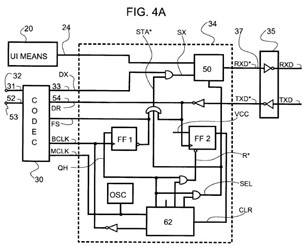
During pre-trial proceedings in the district court, GET attempted to base its description of the way that the logic block 34 synchronizes two data streams on a single element within the logic block 34, while ignoring the other elements. In particular, GET attempted to describe the way that the logic block 34 synchronizes two data streams as “synchronizing both to a common bit-rate clock”, while ignoring other elements within the logic block 34, such as the data selector 50 that samples two data streams to create synchronized output.[1] This narrow focus on just the bit-rate clock signal BCLK from block 34 enabled GET to argue that the claimed and accused structures were equivalent without ever viewing a Bluetooth module schematic. The district court rejected GET’s attempt to broadly define the “way” in this manner, and granted Sony’s motion for summary judgment of non-infringement.
The Federal Circuit affirmed, determining that merely comparing the bit-rate clock of the logic block 34 to the accused product is insufficient to demonstrate that the claimed and accused structures are equivalent. In particular, the court noted that although the determination of structural equivalence does not require mapping each structure in the specification to an equivalent element in the accused product, when the patentee elects to focus its equivalence analysis on something less than the whole structure that is disclosed in the specification, the patentee has an obligation to meaningfully explain why it is permissible to discard the elements. Likewise, the Federal Circuit noted that although the law allows for greater weight to be given to individual components that play a central role in the identified structure, this does not excuse the patentee’s obligation to account for all of the elements of the identified structure and make the case for why certain elements are more central to the infringement analysis than others.
Because GET failed to offer any evidence concerning why elements of the logic block 34 should have been omitted or afforded minimal weight in the infringement analysis, the Federal Circuit determined that no reasonable jury could have concluded that Sony’s products perform the claimed function in substantially the same way as the structure described in the patent.
<Reference Link>
The court decision is available at the following link:
24-1686.OPINION.2-19-2026_2649632.pdf
Please do not hesitate to contact us should you have any questions.
[1] It appears that GET adopted this strategy because it failed to obtain sufficient discovery concerning the internal structure of the Bluetooth module in Sony’s accused products.
- Tad ITOH (President of ITOH, Partner of IPUSA)
Herman Paris (Partner of IPUSA)
Yusuke Arima (Partner of IPUSA)
Yo Kikuchi (Partner of IPUSA)