
IP NEWS

Key Points for Filing Trademark Applications in Japan
Based on the inquiries we receive most frequently, we have summarized below the key considerations when filing trademark applications in Japan.
1. Required Documents and Information
(1) The required documents and information for filing a trademark application in Japan are as follows:
・Bibliographic information (applicant’s name and address)
・Identification number (if already assigned)
・Trademark information (trademark, class, designated goods/services)
・Whether the trademark consists of standard characters or not
・Image data (if required)
No power of attorney is required for filing.
(2) Identification Number
The identification number is a 9-digit number assigned to a person who has previously requested the assignment of an identification number from the Japan Patent Office (JPO), or to a person who files a procedure with the JPO for the first time. It is used to manage the applicant’s name, address, etc. The assigned identification number is notified by an “Identification Number Notice” (if there is an agent, the notice is sent to the agent).
If a procedure is carried out without entering the identification number, a new identification number may be assigned if the information differs from the already assigned identification number.
A different identification number may also be assigned even when there is a discrepancy in the spelling of the applicant’s name or address.
Since one identification number is assigned per individual (or corporation) and a different identification number would cause the applicant to be treated as a different entity — which carries the risk of a prior registered trademark being cited against the application and resulting in rejection — we would greatly appreciate it if you could provide us with your identification number if you have one.
We can verify it to some extent in the JPO database, but the database is incomplete.
2. Standard Character System
(1) Overview
The “Standard Character System” is a system whereby, “when a trademark to be registered consists solely of characters, and the applicant does not claim rights in any particular design or form, the Commissioner of the JPO publishes and registers the trademark as displayed in a specific character typeface (standard characters) pre-determined by the Commissioner of the JPO, based on the applicant’s declaration, simply by entering the trademark in the application form.”
The characters that may be used are designated by the Commissioner of the JPO.
(2) Marks Not Recognized as Standard Characters
Trademarks consisting of more than 30 characters (including spaces) are not recognized as standard characters. Additionally, half-width characters and half-width spaces are not recognized as standard characters.
(3) Relationship with Priority Claims
Among trademark applications filed in Japan claiming priority, there may be cases where the basic first-country application on which the priority is based consists of standard characters. However, since the range and form of characters recognized as standard characters differ between each country’s standard character system and Japan’s standard character system, the “identity of the trademark” for the purpose of the priority claim becomes an issue.
In this regard, the determination of “identity of the trademark” for the purpose of a priority claim is premised on being made based on the trademark displayed in the priority certificate, etc., regardless of whether the basic first-country application on which the priority is based consists of standard characters or not.
The trademark displayed in the priority certificate is then compared with:
(i) the trademark entered in the application form in a case where the Japanese trademark application is not in standard characters; or
(ii) the trademark as expressed when converted into standard characters in a case where the Japanese trademark application is in standard characters.
Incidentally, where the trademark shown in the priority certificate, etc. consists of characters displayed in a typeface generally used in electronic devices, and the trademark entered in the application form consists of standard characters or characters displayed in a typeface generally used in electronic devices, the trademarks will be treated as substantially identical, unless there are special circumstances.
(4) Scope of Rights
The scope of an ordinary registered trademark is determined based on the trademark entered in the application form (Trademark Act, Article 18, paragraph 3; Article 27, paragraph 1). However, the scope of a registered trademark consisting of standard characters is determined not based on the trademark as entered in the application form itself, but based on the trademark as expressed when converted into standard characters.
If a specific character typeface has been decided for use, we recommend filing a trademark application using that typeface rather than standard characters.
Please note that, where a trademark is registered in standard characters, the scope of the trademark right extends to the same or similar range as the registered trademark (standard characters), and there is no difference in the breadth of the scope compared to ordinary trademark registration.
3. Similar Group Codes
A trademark application cannot be registered if the applied trademark is identical or similar to another person’s registered trademark and the designated goods or services covered by the application are identical or similar to those of the registered trademark (Trademark Act, Article 4, paragraph 1, item 11).
In examining whether an applied trademark falls under the above grounds for rejection, the JPO determines the similarity of the designated goods or services of the applied trademark and those of another person’s registered trademark based on the “Similarity of Goods and Services Examination Criteria.”
These “Similarity of Goods and Services Examination Criteria” group together goods that share commonalities in terms of production sector, sales sector, raw materials, quality, etc., or services that share commonalities in terms of means of provision, purpose, or place of provision, etc., and presume that, in principle, goods or services belonging to the same group are similar to each other.
Each good or service in each group is assigned a five-digit common code consisting of a combination of numbers and letters, called a “Similar Group Code.”
In examination practice, goods and services assigned the same similar group code are presumed, in principle, to be similar to each other.
The same similar group code exists not only within the same class but also in many other classes.
Example:
Class 14 – Jewel cases (20A01) / Class 20 – Furniture (20A01) → Similar
Therefore, when conducting searches or examining grounds for rejection, it is necessary to be mindful not only of the Nice Classification but also of the Similar Group Code.
4. Examples Where Classifications Differ Between Japan and Foreign Countries
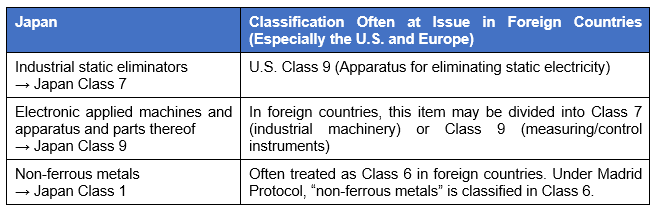
5. Examples Where Terminology Differs Between Japan and Foreign Countries
Example: Class 5
English (Madrid Protocol, TM5): Tissues impregnated with antibacterial preparations
Japanese: ティッシュに洸み込ませた抗菌劑 (Reference Translation: Antibacterial agent impregnated into tissues)
・In foreign countries (English), the focus is on “Tissues,” whereas in Japan (Japanese), the focus is on “antibacterial preparations.”
・In Japan, there is a tendency in Classes 5 and 3 to identify such goods as “pharmaceutical agents” such as antibacterial agents, bactericides, and disinfectants, whereas in English-speaking countries, there is a tendency to focus on the “product form” such as wipes, tissues, and pads.
・Strictly speaking, the above example involves different scopes of rights; however, since examination generally proceeds on the premise that the original text and the translated text correspond to each other (including in Japan), in practice, such goods are not often treated as completely different products.
ITOH Patent Attorney Corporation
Tad ITOH, President
Yasunari HIGASHI, Trademark Attorney
Keiko NOZAKI, Trademark Attorney